


ANNOUNCEMENT
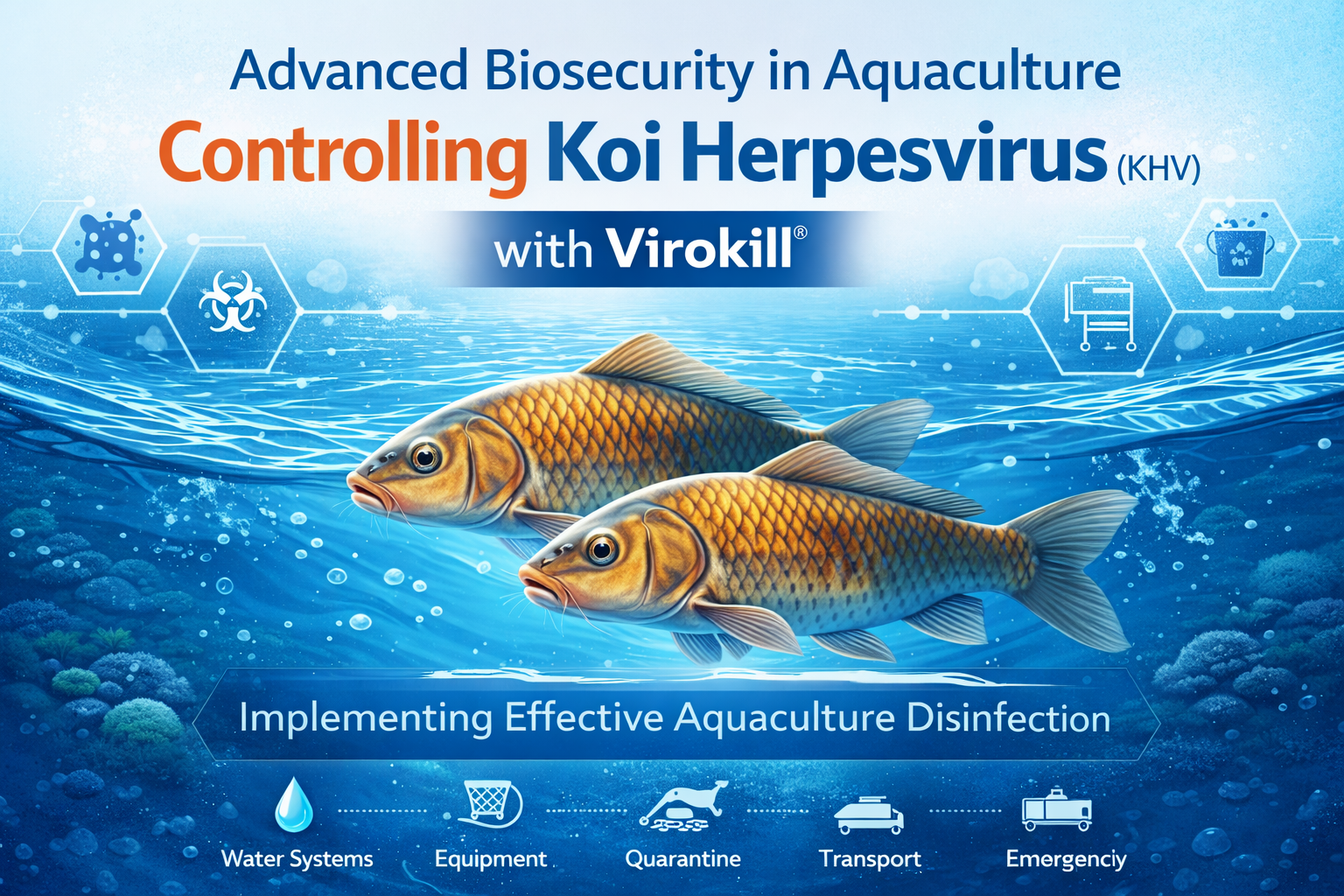
Advanced Biosecurity in Aquaculture: Controlling Koi Herpesvirus (KHV) with Virokill®

A Scientific and Professional Perspective for the Aquatic Health Sector
Koi Herpesvirus Disease (KHVD), caused by Cyprinid Herpesvirus-3 (CyHV-3), represents one of the most serious biological threats to both ornamental koi and food-fish carp production worldwide. With reported mortality rates reaching 80–100% under favorable conditions, KHV outbreaks lead to severe economic losses and long-term biosecurity challenges.
As part of its commitment to sustainable veterinary and aquaculture solutions, The Arab Pesticides & Veterinary Drug Mfg. Co. (MOBEDCO) provides Virokill® as a scientifically validated disinfectant for comprehensive aquatic biosecurity.
1. Koi Herpesvirus: Epidemiology and Pathogenesis
1.1 Biological Characteristics
KHV is an enveloped double-stranded DNA virus that primarily targets:
Gill epithelium
Skin and mucus layers
Renal and hematopoietic tissues
Its lipid envelope is essential for infectivity, making it vulnerable to oxidative and surfactant-based disinfectants.
1.2 Temperature Dependency
Disease expression is strongly correlated with water temperature:
Optimal replication range: 16–25°C
Below 13°C: latent or subclinical infection
Above 28°C: reduced viral activity
This “thermal window” explains the seasonal peaks observed in spring and autumn.
1.3 Carrier State and Transmission
Recovered fish remain lifelong carriers and may shed virus under stress conditions such as:
Transport
Handling
Overstocking
Poor water quality
Transmission occurs through:
Direct fish-to-fish contact
Contaminated water
Shared equipment (nets, tanks, transport containers)
Consequently, eradication depends primarily on preventive biosecurity and environmental disinfection.
2. Virokill®: Chemistry and Mode of Action
2.1 Active Technology
Virokill® is based on stabilized potassium peroxymonosulfate (PPMS) combined with optimized surfactant systems.
This formulation enables:
High oxidative potential
Effective penetration of biofilms
Stability in organic-rich water
2.2 Mechanism of Viral Inactivation
Virokill® inactivates KHV through a multi-step process:
Surfactant Penetration
Lowers surface tension, enabling access to viral particles and mucus layers.Envelope Disruption
Destabilizes the lipid bilayer of the virus.Oxidative Denaturation
Oxidizes viral proteins and nucleic acids, preventing replication.
Scientific studies confirm that PPMS-based disinfectants achieve >99.999% viral reduction even under high organic load and low-temperature conditions.
3. Advantages of Virokill® over Conventional Disinfectants
| Parameter | Virokill® (PPMS) | Potassium Permanganate | Chloramine-T | Chlorine |
|---|---|---|---|---|
| Virucidal Activity | Excellent | Limited | Moderate | High (unstable) |
| Organic Load Resistance | High | Low | Low | Very Low |
| Fish Safety (at dose) | High | Low | Moderate | Very Low |
| Environmental Impact | Biodegradable | Moderate | Moderate | High |
| Equipment Compatibility | Non-corrosive | Corrosive | Moderate | Corrosive |
Virokill® combines high antimicrobial efficacy with operational safety, making it suitable for continuous use in aquaculture systems.
4. Application Protocols for KHV Control
Effective biosecurity depends on maintaining validated concentration–time (C×T) parameters.
4.1 Routine In-Water Sanitization (Preventive Use)
Objective: Reduce background viral and bacterial load.
Dosage: 1 g / 1,000 L
Frequency: Once per week
Application: Pre-dissolve in water and distribute in high-flow areas
Recommendation: Switch off UV/ozone for 6–12 hours
This dose maintains viral suppression without compromising nitrifying bacteria.
4.2 Enhanced Protection (High-Risk Periods & Quarantine)
Objective: Control viral shedding during stress and acclimation.
Dosage: 2 g / 1,000 L
Frequency: Every 3 days for 21 days
Use cases:
New stock introduction
Show preparation
Seasonal temperature transition
Monitor dissolved oxygen and ammonia levels during intensive programs.
4.3 Equipment and Facility Disinfection
Objective: Prevent mechanical transmission.
Concentration: 1% solution (10 g/L)
Contact time: ≥10 minutes
Applications:
Nets and bowls
Transport tanks
Footbaths
Handling tools
Rinse with clean water before reuse.
4.4 Terminal Pond Sterilization (Post-Outbreak)
Objective: Complete system reset after KHV detection.
Dosage: 20 g / 1,000 L
Fish status: Empty system only
Application: Once, followed by flushing and drying
This protocol eliminates residual viral reservoirs in biofilms and sediments.
5. Integration into Aquaculture Biosecurity Systems
For maximum effectiveness, Virokill® should be embedded in Standard Operating Procedures (SOPs):
5.1 Core Biosecurity Measures
Controlled access to facilities
Dedicated equipment per unit
Mandatory foot dips
Routine water disinfection
Quarantine of new stock
5.2 Monitoring and Documentation
Record dosing schedules
Track water parameters (pH, DO, NH₃, NO₂⁻)
Maintain disinfection logs
Verify equipment sanitation
This systematic approach ensures regulatory compliance and operational continuity.
6. Environmental and Occupational Safety
Virokill® offers a favorable safety profile:
Degrades into oxygen and potassium salts
No persistent residues
Low corrosivity
No occupational exposure limits when used correctly
This makes it compatible with modern sustainability and environmental discharge standards.
7. Strategic Value for Commercial and Ornamental Operations
By reducing pathogen pressure, Virokill® contributes to:
Lower mortality rates
Improved growth performance
Faster recovery after treatments
Reduced antibiotic dependency
Enhanced export and certification compliance
For high-value koi collections and intensive carp production, this translates into measurable economic and reputational benefits.
Conclusion
Koi Herpesvirus remains a permanent risk in global aquaculture due to its high infectivity and lifelong carrier state. Curative treatment is not currently available; therefore, prevention and environmental control are the only reliable management strategies.
Virokill®, supported by scientific evidence and professional application protocols, provides a comprehensive solution for:
In-water viral suppression
Equipment sterilization
Facility disinfection
Long-term biosecurity management
Through its advanced oxidizing technology, operational safety, and environmental compatibility, Virokill® represents a cornerstone of modern aquatic health programs.
By integrating Virokill® into structured biosecurity systems, aquaculture professionals can effectively break the transmission cycle of KHV and safeguard the sustainability of their production and ornamental assets.


